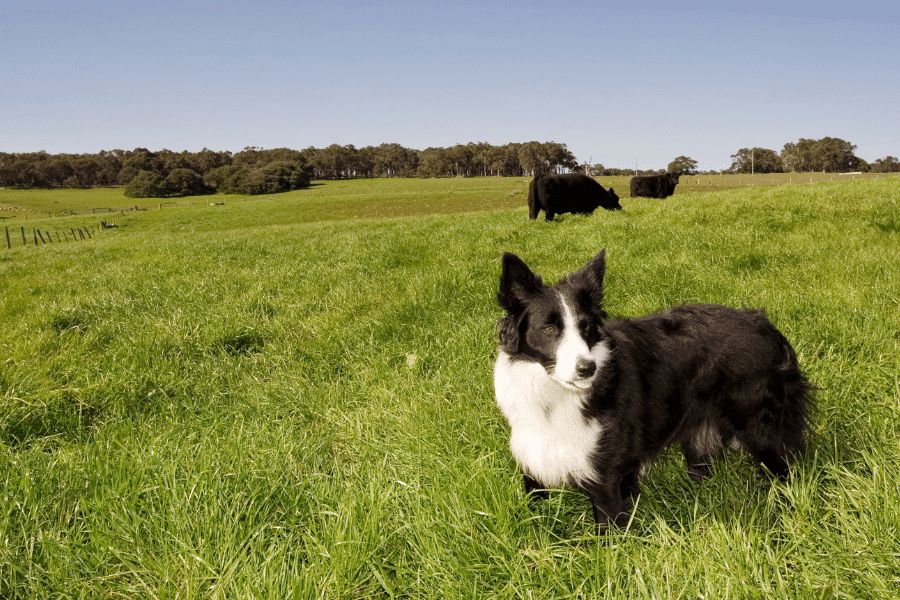












There are so many joint supplements on the market these days, it can be overwhelming to figure out which one is the right one for your pet! As a vet, these are the things that I look for 🙂
This article is based on the published research, guidance from Canine Arthritis Management (CAM), one of the leading authorities on canine joint disease, and what I see every day in practice. I’ve gone through it by ingredient rather than by brand, because a product is only ever as good as what’s actually in it and how much of it there is.
What a good joint supplement looks like
- It contains an ingredient that has been tested and worked.
- It carries enough of it per day for your pet’s weight.
- The ingredient is in a form your pet can absorb.
- It’s fresh, and packaged so it stays that way.
- The company will show you all of the above without you having to dig.
Do joint supplements actually work for dogs?
Some of them really do, yes, but it depends on what’s in them, how much your dog gets, and the form it comes in. Marine omega-3 has the strongest overall evidence for dogs with arthritis. Specific green lipped mussel lipid extracts have also produced encouraging results in controlled trials. Glucosamine and chondroitin are popular, but the evidence for relieving arthritis pain is disappointing, which surprises a lot of people.
It’s worth knowing what a supplement can and can’t do before you start as well. Arthritis isn’t just wear and tear, there’s an inflammatory process going on in the joint that keeps feeding itself, and that’s the part supplements work on. They’re not going to rebuild cartilage or loosen off a stiff joint, so they sit alongside keeping your dog lean, regular gentle exercise and pain relief when it’s needed, rather than doing the job on their own.
Here’s where each ingredient sits, starting with the ones I’d happily put my own dog on.
The ones with solid research behind them
Marine omega 3, from fish oil or krill oil. This has the best evidence of anything for dogs with joint disease, and it’s not close. In a 131-dog study published in JAVMA, dogs eating a fish-oil-enriched diet were able to reduce their carprofen dose faster than dogs eating the control diet, and a big multicentre trial across 18 clinics where they got up, played and walked better over six months. In 2022 an independent group went through every trial they could find in this whole area, 72 of them, and omega 3 came out on top. When you’re reading the label it’s the EPA and DHA you want to add together, not the weight of the fish oil, because a 1000 mg capsule might have 300 mg of the two in it or half that and the front of the pack won’t tell you, which is a bit annoying. Most vets aim for 80 to 100 mg of EPA and DHA per kilo per day, so 1,600 to 2,000 mg for a 20kg dog, which on a 300 mg capsule is five to seven a day, far more than most people expect!
One thing to watch with omega 3 is where it comes from. Flaxseed, linseed and hemp oil are plant omega 3, called ALA, and dogs only turn a tiny amount of it, under 5 percent, into EPA and almost none into DHA. It’s a lovely oil for the coat, but it doesn’t do what the fish oil trials did, however good the label sounds.
Green lipped mussel oil extract.
Green lipped mussel oil extract. Our own New Zealand mussel, and I’m really pleased with how the research on its lipids has come along. In a blinded 2023 study, dogs given a particular mussel lipid extract put more weight through their sore leg than dogs given a placebo, with a change similar to the carprofen group. A mussel-and-krill lipid formulation also did well in that study and in a 2024 trial that included meloxicam. Those are impressive comparisons, although they don’t mean every mussel oil has been shown to work like a prescription anti-inflammatory. A New Zealand pilot study in working farm dogs also found improvements in some activity measures with a full-fat mussel extract. On the label, I want to know exactly what extract I’m getting and how much is in the daily dose. A concentration ratio, such as 125:1, tells me about the amount of fresh mussel used to make an extract; it doesn’t by itself prove that two different extracts have the same clinical effect. One of the controlled studies used 5 mg per kilo per day of its particular mussel lipid preparations, so I use that as context when reading a label, rather than as a universal dose for all mussel oils.
Some research, but not a lot yet
Green lipped mussel powder. The whole mussel, dried and ground. There are a few blinded trials in dogs and they’ve been positive, although the preparations, doses and study methods differ enough that I wouldn’t rank every powder against every oil just by its weight on the label. One of them found no difference at four weeks and a clear one at eight, so be patient with it.
PEA (palmitoylethanolamide). This is a fatty compound the body makes itself, and I think it’s one of the more interesting newer ingredients for joint comfort. In a blinded, placebo-controlled 2026 study of a specific PEA formulation called Levagen+, 76 out of every 100 dogs met the study’s definition of treatment success, compared with 40 out of 100 on placebo. That’s a really encouraging start, although we need more trials. The form matters here: Levagen+ uses a technology called LipiSperse to improve dispersibility, while other products may use micronised PEA. They’re different formulations, so I wouldn’t treat equal milligrams as proven equivalent. The 2026 study used weight-band doses, including 600 mg a day for dogs weighing 20 to 34.99 kg.
Undenatured type II collagen (you’ll see it written UC-II). This isn’t the same as the collagen powder in most chews, and that really matters. In a 60 dog trial it improved mobility about as much as an anti-inflammatory did, though there was no placebo group in that one, and a small blinded study paired it with boswellia and it beat the placebo. Ordinary hydrolysed collagen came out weak in the 2022 review, so the form is the whole point here. It’s a flat 40 mg a day rather than by weight, which is a bit unusual.
Curcumin. The active part of turmeric, and on its own it barely absorbs, so most of a big dose of ordinary turmeric powder goes straight through your dog. In dogs it’s been shown to turn down the same inflammation genes an anti-inflammatory drug does, but the trials that measured how the dogs actually moved have come out mixed, so I’d treat it as a useful part of a mix rather than the reason to buy something. Look for an extract made for absorption, and check whether the number on the label refers to the weight of the turmeric extract or the amount of curcuminoids. They aren’t necessarily the same thing. One dog study used about 6.6 mg of curcumin per kilo per day and found changes in inflammatory gene expression; that’s interesting research, although it doesn’t establish an effective dose for improving mobility.
Epiitalis (the seed oil in 4CYTE). It comes from a conifer called Biota orientalis and works on the same pathway as fish oil. A trial of a 4CYTE product containing Epiitalis plus three marine ingredients found results comparable with carprofen on its measured outcomes. A later placebo-controlled trial of 4CYTE Epiitalis Forte gel didn’t separate clearly from placebo on the force plate, so for me it’s a mixed picture.
Boswellia. One open trial in 29 dogs where 71 percent improved, but there was no placebo group so nobody knows how many would have improved anyway. It turns up in a lot of mixtures, and the dose in that trial was 400 mg per 10kg a day.
Eggshell membrane. The early work in dogs was mostly checking it was safe, and the positive 2025 trial in 52 dogs used a mixture with krill, hyaluronic acid and boswellia, so nobody can really say which part did the work.
Not much to go on
Glucosamine and chondroitin. This is the one everybody asks me about, and sorry, the answer isn’t what people want to hear. The 2022 review found nine trials and no effect, and the authors went as far as saying it shouldn’t be recommended for arthritis pain in dogs and cats any more. If your dog is on something with glucosamine in it alongside other actives, it may well still be helping them, it’s just unlikely to be the glucosamine doing it.
Deer velvet antler. There’s one placebo controlled trial in dogs from 2004 and nobody has repeated it in over 20 years. One old trial isn’t something I’d hang a decision on.
MSM. I couldn’t find a single trial in dogs, and the human ones are small and mixed.
Hyaluronic acid by mouth. Injected into a joint by your vet it has good evidence, but swallowed there’s no dog trial of it on its own, only inside mixtures.
Abalone and shark cartilage. No dog trials that I can find.
How do I read the label?
It honestly takes about two minutes once you’ve done it once, and it’s the part that tells you more than anything on the front of the pack.
1. Turn the pack over. The front is marketing. If the actives and their amounts aren’t on the back at all, you’re done, because there’s nothing to check.
2. See what each active is quoted per. It’s almost always per chew, per tablet or per scoop, never per day, and this is where nearly everybody goes wrong!
3. Work out the daily amount for your pet. The amount per chew, times however many chews their weight calls for.
4. Check the form, not just the name. EPA and DHA added up, and marine rather than plant. A ratio on the mussel. Curcuminoids rather than turmeric. Micronised on the PEA. Undenatured on the collagen.
5. Compare the daily dose with what was actually studied.
| Your dog | EPA + DHA | Mussel oil extract | PEA | Curcuminoids | UC-II collagen | Boswellia |
|---|---|---|---|---|---|---|
| 10kg | 800 to 1,000 mg | about 50 mg | about 100 mg | about 65 mg | 40 mg | 400 mg |
| 20kg | 1,600 to 2,000 mg | about 100 mg | about 200 mg | about 130 mg | 40 mg | 800 mg |
| 30kg | 2,400 to 3,000 mg | about 150 mg | about 300 mg | about 200 mg | 40 mg | 1,200 mg |
| 40kg | 3,200 to 4,000 mg | about 200 mg | about 400 mg | about 265 mg | 40 mg | 1,600 mg |
These aren’t rules. The omega 3 figure is the range vets usually aim for. The remaining figures show amounts used with particular preparations in individual studies, which measured different outcomes. They’re useful reference points, but I wouldn’t use them as a dosing instruction for a different product. You won’t find one product with all of it, and an ingredient under these numbers isn’t doing nothing, it’s just not doing what the study did.
6. Check it’s fresh, which is the next bit.
Does the oil go off?
It does, and hardly anybody mentions it. This goes for fish oil, krill oil, mussel oil and flax alike, and it’s why two products with identical numbers on the label can be very different by the time they get to your dog. Omega 3 reacts with air, it’s the same thing that turns cooking oil rancid, and it starts the moment the oil meets oxygen and speeds up with warmth and light. Oxidation can affect oil quality, which is why good packaging, sensible storage and batch testing matter.
Your nose can give you a useful warning. If an oil smells sharply rancid, sour or like an old deep fryer, I wouldn’t give it to my dog. A mild smell, though, can’t prove that an oil is fresh or that the EPA and DHA still match the label; that takes testing. If your dog suddenly turns their nose up at an oil they used to eat happily, it’s worth checking the storage instructions and use-by date too.
The things that keep it fresh are:
- A sealed single dose. A softgel or a sachet holds one dose with no air in it until you open it, whereas a bottle or a tub gets opened every day for weeks. Powders and oiled chews are the hardest of all, because the oil is spread thinly over a lot of surface with air on all of it.
- Dark packaging, and the cupboard rather than the windowsill. Nowhere near the oven, and a liquid usually wants the fridge once it’s open.
- TG or rTG on a fish oil label. That’s the triglyceride form, the shape the oil is in naturally. Ethyl ester is cheaper to make, less stable and not as well absorbed.
- Added vitamin E, sometimes written tocopherols, which is there to protect the oil in the pack.
- A batch number and a use by date.
- Freshness numbers, if the company publishes them. Peroxide value, anisidine value, and TOTOX which combines the two, and lower is fresher. Hardly anybody publishes them, so a company that does is telling you something.
How do I know if the company is any good?
Stephen Fox, who wrote Multimodal Management of Canine Osteoarthritis, came up with a really useful way of sizing up the company behind a supplement rather than just the pack, and CAM have made it the standard advice for owners. It spells ACCLAIM.
- A, an established company you can actually find, putting something back into vet education rather than only into advertising.
- C, clinical evidence. Trials cost a lot of money, so a company that has paid for them will make them easy to find. Published in a journal, not a page of testimonials.
- C, content. Every ingredient listed with a number beside it.
- L, label claims. Nothing cures arthritis and nothing prevents it.
- A, administration. A dose you can work out off your own dog’s weight.
- I, an identification number. A batch number, so a batch can be traced and tested.
- M, the manufacturer. Named, with a website, and somewhere you can send a question.
How will I know if it’s working?
This one’s harder than people expect, because arthritis goes up and down on its own, so a good week doesn’t prove much and neither does a bad one. What you’re looking for is the little things creeping back over a couple of months, getting up off their bed a bit more easily, not being quite so stiff first thing in the morning, managing the stairs or jumping into the car again, or holding a longer walk without paying for it the next day.
Because it all happens so gradually it’s really easy to miss, so CAM’s advice, and mine, is to note where your dog is before you start anything. Pick the two or three things they struggle with most and film one of them on your phone, then leave it alone for two to three months and film the same thing again. That comparison will tell you far more than trying to remember how they were back in July, and it saves so many dogs being taken off something before it’s had any chance to work.
Where Nuvetra fits
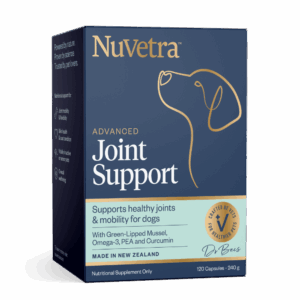
Nuvetra Advanced Joint and Skin Support for Dogs was a real passion project of mine 🙂 I wanted a joint product that was backed by science and had proper levels of active ingredients, something I could truly believe in, so it’s only fair I put it through exactly the same checks as everything else.
It has both ingredients from the top tier, marine omega 3 and green lipped mussel oil extract, and two from the middle, micronised PEA and HydroCurc, which is a form of curcumin made for absorption. There’s no glucosamine in it and that’s very much on purpose. It doesn’t have type II collagen either, so if that’s what you’re after, it isn’t the one for that. At one capsule per 10kg of body weight once a day, this is how it lines up.
| In a capsule | A 20kg dog gets | Against the studies |
|---|---|---|
| EPA 490 mg and DHA 367 mg | 1,714 mg EPA and DHA | within the 80 to 100 mg per kilo range |
| Mussel oil 40 mg, a 125:1 extract, about 5,000 mg fresh equivalent | 80 mg of concentrated extract | close to the 100 mg the trials used |
| PEA 100 mg, micronised | 200 mg | on the study dose, in the study’s form |
| Curcumin 100 mg, as HydroCurc | 200 mg | above the dog study dose |
The fish oil is a triglyceride concentrate sealed in a softgel, so each dose only meets the air when you open it, and batches are independently tested by the Cawthron Institute in Nelson, where the EPA, DHA and PEA all came back at or above what’s on the label.
There are two things my own checklist makes me tell you about my own product. The absorption work behind HydroCurc was done in people rather than dogs, and the four ingredients haven’t been studied together as the finished Nuvetra formula. Some of the encouraging mussel and PEA studies also used different formulations, so I won’t claim Nuvetra reproduced those trials. I chose these ingredients, forms and amounts because I think they make a thoughtful, genuinely strong joint-support formula—and I’m happy to show you exactly what’s in every capsule.
What about cats?
The same checks apply, there’s just a much shorter shelf, because nearly all the research has been done in dogs and Nuvetra is made for dogs I’m afraid. Cats also hide this far better than dogs do, so if yours has gone a bit quiet, stopped jumping up onto the bench, or started sleeping somewhere lower down, that’s a vet visit rather than a supplement.
My advice as a vet
Turn the pack over, find the ingredient in the tiers above, and work out the daily dose for your own dog rather than the dose per chew. Look at the form, not just the name, give the oil a sniff, and write down how your dog is today before you start anything so you’ve got something to compare against in three months.
And please do the free things too, because they genuinely help more than anything sitting on our shelves. Keeping your dog lean is the big one, and I know it’s the least welcome thing to hear, but every extra kilo goes through those sore joints with every single step. Little and often beats one big walk at the weekend, non slip mats on wooden and tiled floors make such a difference, and if your dog is genuinely sore then they do need pain relief from your vet rather than just a supplement.
If you’d rather just ask me, email me at rebecca@vetpost.co.nz with your dog’s age and weight and what they’re on at the moment, and I can offer some advice 🙂
Questions we get asked
What’s the best joint supplement for dogs in NZ? It really comes down to what’s in it and how much rather than the brand, so start with the top tier above, marine omega 3 and green lipped mussel oil, and then check the dose against the table. I’m biased of course, but that’s exactly why I made Nuvetra the way I did 🙂
How long do joint supplements take to work? Six to eight weeks at the full dose at the very least, and CAM suggest giving it two to three months before you decide. Any less than that and you’re really just guessing.
Are joint supplements safe? The ingredients with the best evidence are generally very well tolerated, although fish oil can upset some tummies to start with. Anything with mussel or fish in it isn’t one for a dog with a seafood or shellfish allergy, and if your dog is on other medication or has anything else going on, have a chat with your vet first.
Can I give a supplement alongside my dog’s arthritis medication? Usually yes, and plenty of dogs are on both, but do check with your own vet first because they’ll know everything else your dog is on.
Shop Nuvetra at Vetpost
You might also like What Joint Supplement Should I Choose for my Dog?, which goes through what we stock with the daily cost worked out, and our Arthritis Hub. We also have a 12 page guide, Canine Osteoarthritis: A Modern Management Guide, just email us and we’ll send it over, and Canine Arthritis Management are another wonderful resource, with a great website and Facebook page. Dr Rebecca Walker BVSc
Disclaimer
This article is general information and not veterinary advice for an individual animal. Always talk to your vet before starting or changing a supplement, particularly if your dog has a health condition, is pregnant or nursing, or is on other medication. Doses quoted are from published studies and manufacturer labels at time of writing.